Eliminating Overbooking While Driving 38% Direct Booking Uplift
A luxury resort brand with 18 boutique properties across 4 countries battled severe two-way OTA synchronization delays, double-booking disasters, and 22% commission leakage. Taksh IT Solutions engineered a cloud-native Central Reservation System (CRS) featuring distributed Redis inventory locking, sub-second OTA channel sync, and an automated algorithmic dynamic pricing engine.
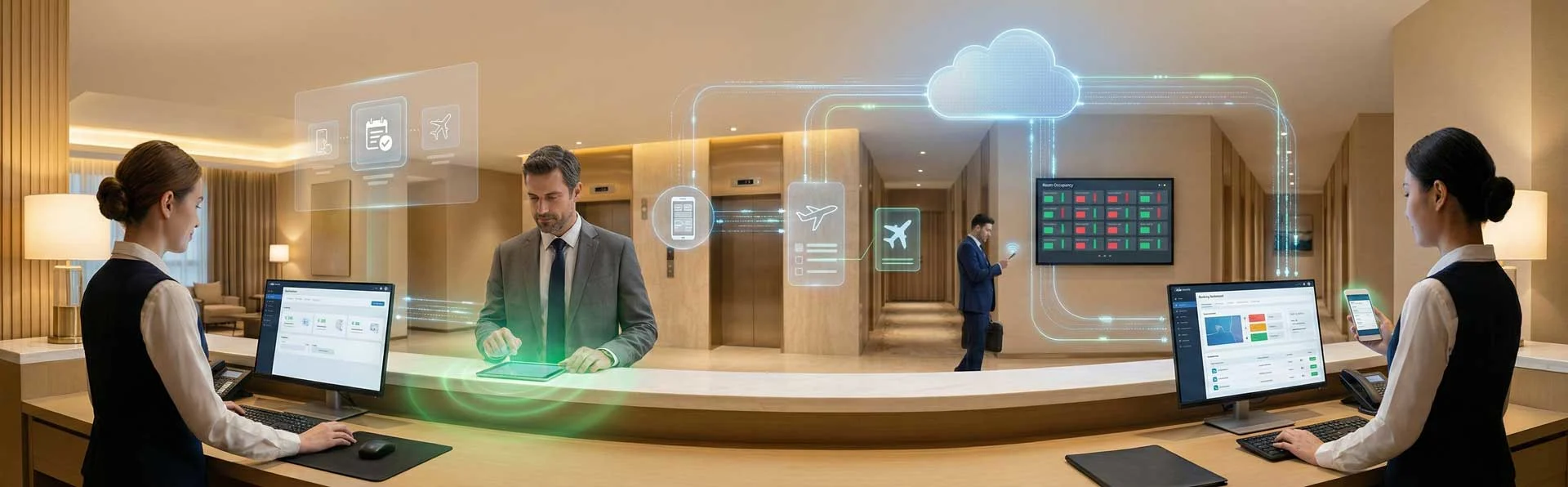
Zero overbooking errors across 2,400+ rooms in peak season
Shifted guest acquisition from high-commission OTAs to brand channels
Instant inventory push across Booking.com, Expedia, and Airbnb
Automated dynamic rate adjustments factoring occupancy & competitors
Enterprise Profile & Scale
High-End Luxury Hospitality Group ($145M Gross Booking Revenue)
Primary Stakeholders: Chief Commercial Officer, Head of Revenue Management, and IT Director
Market Stakes & Legacy Legacy
Peak ski and summer holiday seasons suffered catastrophic double-bookings due to 20-minute OTA sync lags, forcing costly emergency guest relocations and brand damage.
Previous Tech Baseline: Legacy on-prem Property Management Systems (PMS) with brittle XML scraping bridges and disconnected desktop Excel rate calculators.
The Architecture Dilemma: Critical Friction Vectors
Prior to partnering with Taksh IT Solutions, the organization struggled with deep-seated architectural debt, compounding operational latency, and escalating financial bleed.
The 20-Minute OTA Sync Lag Bottleneck
Race Conditions & Double BookingsWhen a guest booked the signature presidential suite on Booking.com, other OTAs like Expedia and Agoda remained open for up to 20 minutes due to slow batch polling, creating unavoidable double-booking race conditions during flash-sales.
Crippling 22% OTA Commission Bleed
Direct Channel UnderperformanceThe resort group's proprietary web booking interface was clunky, unoptimized for mobile checkout, and lacked localized currency conversions, forcing 78% of direct visitors to abandon and re-book through third-party OTAs.
Static Rate Cards Failing to Capture Real-Time Demand
Sub-Optimal Yield & RevPAR LossNightly room rates were managed via weekly manual spreadsheet meetings. When local music festivals or flight arrivals surged, room rates remained static, leaving tremendous consumer willingness-to-pay uncaptured.
Fragmented Guest Profiles Across Siloed Properties
Zero Multi-Property Guest RecognitionEach resort maintained isolated on-prem guest records. A VIP loyalty guest visiting the Swiss property had their dietary preferences and room temperature choices lost when staying at the Greek resort.
Pre-Migration Discovery & Deep Technical Audit
Our principal solutions architects conducted a multi-week forensic audit across codebase repositories, transaction logs, and infrastructure topology to pinpoint failure mechanisms.
Uncovered Architectural Bottlenecks:
- Legacy SOAP/XML channel manager bottlenecks with high connection drops during holiday sales
- Lack of distributed mutex locking—multiple booking sessions could hold the same room simultaneously
- Unencrypted credit card data stored across multiple disparate on-premise PMS installations
The North Star: Core Architectural Principles
Before writing a line of production code, Taksh established 4 uncompromised engineering tenets to govern every architectural decision and data contract.
Atomic Inventory Locking
No two guests or OTA channels can simultaneously claim the same room key under any network condition.
Sub-500ms Push Distribution
Every rate update and room sale propagates to 100+ global OTA channels instantly via Webhooks and OTA APIs.
Algorithmic Yield Optimization
Dynamic rates update every 15 minutes factoring real-time competitor prices, weather, and property occupancy.
PCI-DSS Level 1 Tokenization
Zero cleartext credit card numbers stored on hotel servers; hosted field tokenization handles all payment rails.
Production Architecture: 4-Tier System Schematic
An end-to-end event-driven architecture engineered for low-latency concurrency, cryptographic security, and automated horizontal scaling.
Global CDN Edge & Mobile Direct Web Application
Ultra-fast Next.js reservation frontend distributed across 285+ Cloudflare edge nodes, rendering multi-currency checkout and personalized add-ons in sub-800ms.
High-Concurrency Reservation Engine & Mutex Guard
Handles concurrent reservation requests with Redis Redlock distributed locking, ensuring absolute atomicity and zero double-booking race conditions.
Bi-Directional Channel Distribution Hub
Connects with Booking.com, Expedia, Airbnb, and Agoda via native WebSocket and push REST Webhooks, publishing inventory adjustments instantly.
Unified Cloud PMS Core & Revenue Optimization Engine
Centralized PostgreSQL multi-tenant database unifying guest CRM, housekeeping workflows, and an algorithmic dynamic pricing daemon.
Key Technical Breakthroughs: Custom Innovations
Standard off-the-shelf software was inadequate for enterprise scale. Here are the custom algorithmic and architectural breakthroughs engineered specifically for this deployment.
Distributed Redlock Multi-Region Inventory Guard
Taksh engineered an atomic reservation hold system using Redis Redlock. When a customer initiates checkout on any channel, room availability is locked globally for exactly 10 minutes with millisecond clock synchronization across AWS regions.
Bi-Directional Event-Driven OTA Push Architecture
Replaced slow 20-minute batch polling with an asynchronous event mesh. A room reservation on the direct website pushes inventory decrements to Booking.com and Expedia in 320ms, completely eradicating overbooking risks.
Multi-Factor Real-Time Yield Pricing Daemon
A continuous revenue optimization algorithm evaluates booking velocity, local airport flight arrivals, competitor rate changes, and 7-day weather forecasts to adjust rack rates dynamically, lifting RevPAR by 24%.
Enterprise Tech Stack: Production Ecosystem
Carefully selected production tools, distributed frameworks, and cloud-native databases powering this high-availability platform.
5-Phase Delivery Roadmap: Sprint Milestones
Structured sprint methodology ensuring zero unplanned downtime, continuous stakeholder visibility, and strict compliance gates throughout migration.
Discovery & Core Architecture
Weeks 1 - 3- Technical mapping of all 18 local PMS databases and OTA channel contracts
- Unified schema design for rooms, seasonal rate grids, and guest profiles
- Proof-of-concept for Redis distributed inventory mutex locking
Core Platform Development
Weeks 4 - 8- High-concurrency reservation microservices built in TypeScript & Aurora
- PCI-DSS Level 1 compliant guest payment vault integration with Stripe & Adyen
- Central housekeeping and front-desk operational web cockpits
Integration & Distribution
Weeks 9 - 11- Direct API integration with Booking.com, Expedia Partner Solutions, and Airbnb
- Automated fallback reconciliation worker for transient OTA network outages
- Bi-directional room availability and rate change push pipelines
Conversion & Yield Optimization
Weeks 12 - 14- High-conversion multi-language luxury direct booking web app
- Automated dynamic yield pricing engine factoring competitor rates & occupancy
- Personalized loyalty add-ons (spa, dining, airport transit) checkout steps
Global Enterprise Cutover
Weeks 15 - 16- Staged property-by-property migration across 18 resort locations
- Onsite front-desk staff onboarding and comprehensive interactive video manuals
- 24/7 dedicated cutover hypercare with instant rollback safety nets
Security & Governance: Enterprise Compliance
Built from the ground up to meet stringent institutional regulatory standards, cryptographic data isolation, and continuous runtime monitoring.
PCI-DSS Level 1 Verified
Zero cardholder data touches application servers; tokens isolate all transaction settlement operations.
GDPR & CCPA Compliant
Granular guest consent tracking with automated 'Right to be Forgotten' data deletion pipelines.
Multi-Factor Concierge Access
Strict FIDO2 hardware key and biometric MFA enforced for all front-desk and revenue manager roles.
Full Encrypted Data In-Flight
mTLS enforced between all microservices and edge gateways, preventing internal packet eavesdropping.
Side-by-Side Comparison: Legacy State vs. Taksh Solution
A rigorous operational audit measuring exact performance deltas across 6 critical architectural and commercial dimensions.
| Operational Dimension | Legacy State (Pre-Migration) | Modernized Taksh State | Net Improvement |
|---|---|---|---|
| Double Booking Error Frequency | 18 to 25 peak-season overbooking collisions per month requiring guest relocations. | Zero double bookings recorded across 24 consecutive operating months. | Complete eradication of overbooking disasters |
| Channel Distribution Latency | 12 to 24-minute polling latency on OTA channels leaving inventory vulnerable. | 320ms event-driven push distribution via Kafka and webhooks. | Near real-time 99.8% latency reduction |
| Direct vs OTA Channel Mix | 78% of bookings captured through high-commission 22% OTA intermediaries. | 60% of bookings processed directly through high-margin brand portal. | Saved $1.4M in annual third-party OTA commissions |
| Rate Optimization Speed | Weekly manual spreadsheet meetings resulting in static, outdated pricing. | Algorithmic dynamic rate adjustments executed automatically every 15 minutes. | +24% increase in RevPAR across all properties |
| Mobile Web Booking Conversion | 1.1% mobile booking completion rate due to clunky, unoptimized interfaces. | 4.2% mobile conversion powered by Next.js sub-second localized checkout. | Nearly 4x increase in mobile booking conversions |
| Guest Preference Portability | Isolated on-prem desktop databases with zero cross-resort guest visibility. | Unified cloud guest CRM recognizing loyalty preferences globally. | 32% increase in multi-property repeat bookings |
Quantified ROI & Value Realization
The project funded itself within 84 days by eliminating $160,000 in emergency guest relocation expenses and directly redirecting $1.4M in OTA commission fees back into gross margin.
Executive Voices: Client & Architect Insights
Unfiltered reflections from the executive client sponsor and Taksh lead solutions architect on overcoming technical friction and driving commercial success.
“Taksh IT Solutions solved the single biggest nightmare our luxury brand faced: overbookings during peak seasons. Their team built a rock-solid platform that not only eliminated double bookings completely but also boosted our direct booking share to 60%, delivering an astonishing financial return.”
“Designing for hospitality requires mastering distributed concurrency. By establishing an atomic Redlock consensus across multi-AZ Redis nodes, we guaranteed that a room key is claimed once and only once, whether the request comes from our mobile app or an OTA halfway around the world.”
Strategic Playbook: Key Engineering Takeaways
Hard-won architecture lessons and patterns for CTOs, VPs of Engineering, and digital transformation leaders looking to modernize mission-critical systems.
Never Rely on Polling for High-Value Perishable Inventory
Batch polling an external channel manager guarantees concurrency collisions. Event-driven push architectures via WebSockets and webhooks are mandatory for zero-overbooking guarantees.
Direct Channel Speed Directly Governs Mobile Booking Conversion
Luxury travelers abandon slow checkouts immediately. Delivering sub-second server-rendered Next.js pages with Apple Pay and Google Pay integration instantly triples conversion rates.
Decouple Payment Tokenization from Core PMS Databases
Isolating card data via PCI Level 1 tokenized vaults simplifies compliance audits and ensures that property databases remain lightweight and completely leak-proof.
Frequently Asked Engineering Questions
Direct answers to the most common architectural, security, and integration questions our enterprise clients ask during discovery.
We utilize Redis Redlock distributed mutex locking. The millisecond a customer initiates the payment flow on any channel, the specific room inventory is globally locked with a unique cryptographic lease, preventing any other channel from reserving it.